This report looks at trending topics between April 2–9, 2026 on Facebook and TikTok.
Osotsi attacked
The most viral phenomenon of the week involved the attack by goons to Vihiga Senator Godfrey Osotsi. He was recuperating in Nairobi after an attack by unknown assailants in Kisumu City. While ODM leaders Edwin Sifuna and James Orengo condemned the assault, calling it politically motivated and aimed at silencing dissent, and warning that the attack was part of a wider plot to incite tribal tensions, Kenya News Flash on April 9, 2026 published misleading and inciting posts following the unfortunate events. In a post, the Facebook page justified that the senator deserved the attack.

On the Kenyan Breaking News Facebook page, a post published on April 9, 2026 claimed that Osotsi had staged his attack as the Wantam political leaders have no agenda for the country. There were mixed reactions from the opposition who blamed their Lakeside counterparts accusing them of following without interrogation.

Drivers of conversation
Rather than engaging on facts and debates that are constructive to the country, Kenya News flash and Kenya Breaking News’ skewed and inciting posts generated heated conversations. The pages apparently aimed at achieving high traffic engagements and further heightening the political distress in the country. The posts purportedly quoted Interior Cabinet Secretary, Kipchumba Murkomen, questioning why Otsosti had travelled to Luo land whereas he is a Luhya. This reflected a broader trend, where political figures have been used on social media to raise political temperatures in the country.
Political Leadership Anxiety
Political transition tensions dominated Facebook discussions, pitting President William Ruto, Deputy President Kithure Kindiki, and his predecessor, Rigathi Gachagua. A notable post that drove engagement featured Interior Cabinet Secretary, Kipchumba Murkomen’s defiant remarks to Gachagua’s political attacks.

The Kenya News Flash on April 7 published a post warning that should Gachagua be killed in Nyandarua during the burial ceremony of Ol Karau Mp David Kiaraho, the government would not be responsible.
This conversation was meant to highlight the fracturing of Mt. Kenya political base where Rigathi Gachagua would be depicted as weak with no political muscle. Massive Facebook users engaged in heated debates regarding the current political events as the 2027 election cycle keeps heating up.
Impact on media
The trends observed between April 2–9 highlighted a continued structural shift in Kenyan digital space, largely dictated by the Facebook platform. The posts generated comments as they acted as clickbaits. However, mainstream media continues to increasingly use Facebook Reels to repackage the political drama in the country. From the comments sections, the analysis period saw an audience struggling to verify political claims made in the viral Facebook posts.
Majembe vs Mbavu
The explosive rivalry between TikTok influencers Majembe (Portifas Odipo) and Mbavu Destroyer (Ferdinand Omondi) turned Vurugu Fight Night into a national spectacle that completely dominated Tiktok and other social media platforms. What began as a heated online exchange quickly escalated into a full-blown beef that pitted the gritty boxing culture of Kisumu’s Manyatta against Nairobi’s Dandora. The tension was at its peak on April 4, 2026, when comedian and media personality Oga Obinna hosted the much-anticipated showdown at the Kasarani Indoor Arena during Vurugu Fight Night. In a dramatic fourth round, Majembe secured a Technical Knockout (TKO) victory after landing a powerful punch that floored Mbavu Destroyer. However, the win was instantly engulfed in controversy, as Mbavu and his supporters vehemently claimed the decisive blow was illegal.
The polarising outcome split the internet into two fierce camps: Team Majembe, who praised his superior technique and composure, and Team Mbavu, who celebrated his raw power while insisting the fight was stolen. Clips, reactions, and heated debates exploded across TikTok and other platforms, transforming the localised feud into one of the most talked-about social media moments in the country and keeping both creators trending long after the final bell.
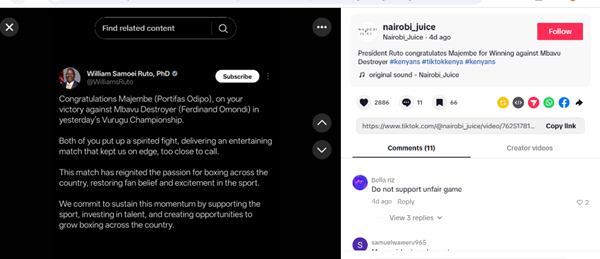
President William Ruto praised Majembe for winning. Other leaders also attended the match including Embakasi East MP Babu Owino, Lang’ata MP Jalang’o and Senator Karen Nyamu.
Ruto vs Gachagua
President William Ruto and former Deputy President Rigathi Gachagua once again dominated headlines on Tiktok and other online conversation platforms following a tense public clash on April 8, 2026, during the requiem mass for the late Ol Kalou MP David Njuguna Kiaraho in Nyandarua County. This marked their first face-to-face encounter since Gachagua’s impeachment, transforming what should have been a solemn occasion into a charged political showdown for influence in the Mt. Kenya region.
Gachagua seized the moment with pointed remarks, reminding Ruto of unfulfilled campaign promises to the area, defending the community against accusations of tribalism, urging the President to rein in interfering allies, and casting himself as a steadfast advocate for regional interests while revisiting the circumstances of his ouster and calling for respect and peace. President Ruto responded in kind, directly countering Gachagua and his allies in an exchange laced with barbs and competing narratives that left little room for decorum.
The dramatic confrontation was aired by many media houses and ignited widespread debate across social media about their deepening rivalry, the shifting dynamics of Mt. Kenya politics, and speculation over whether it signals continued fallout or the seeds of future realignments ahead of upcoming elections. Garnering over 4.1M reach and reactions, more than 6K comments, over 6K reshares, some supported the President while others Gachagua.

Impact on media
The public clash between President William Ruto and his former Deputy Rigathi Gachagua had a significant impact on the media landscape by shifting coverage from a solemn requiem setting to a highly dramatized political spectacle, illustrating how news values increasingly prioritize conflict, personality, and regional power struggles. This confrontation, marking their first face-to-face encounter since the impeachment, has amplified coverage of the deepening rivalry and shifting power dynamics in the politically influential Mt. Kenya region, with newsrooms framing it as an early indicator of realignments ahead of future elections.
The Majembe-Mbavu clash demonstrated the power of social media to elevate grassroots content into a nationwide phenomenon, boosting engagement on TikTok, flooding traditional media with coverage, and highlighting how viral rivalries can drive real-world events, cultural conversations, and even policy interest in sports development in Kenya. The buzz, debates, and lingering controversy continue to ripple through Kenyan media weeks later.
Conclusion
Facebook and TikTok platforms emerged asoperating at the intersection of raw human emotion and high stakes political defense. The period between April 2–9, 2026, reaffirms that both social media platforms are no longer just a social utility. The Majembe–Mbavu spectacle and the Ruto–Gachagua clash revealed a shifting media landscape where drama, rivalry, and personality drove visibility and influence, turning moments into movements and conversations into national obsessions, while reinforcing the growing power of social media to shape narratives, amplify voices, and sustain public attention long after the events themselves.
It is evident that as the 2027 elections approach, Facebook is likely to amplify political tensions because of charged posts from its usersThe most engaging stories originate from prominent political individuals with questionable intentions.