This analysis looks at trending themes between October 21 – 24, 2025 on Facebook, TikTok and X
Firestorm over Kahiga’s Raila death remarks
Nyeri Governor Mutahi Kahiga ignited nationwide uproar following controversial remarks made at a funeral in Laikipia County on October 21, 2025, where he implied that the death of former Prime Minister Raila Odinga on October 15 in India was part of “God’s plan” to protect the Mt Kenya region from Odinga’s political influence and the perceived infiltration of the Orange Democratic Movement (ODM). Speaking in Kikuyu, Kahiga suggested that Odinga’s death would redirect government projects to Mt Kenya, a statement many Kenyans interpreted as celebratory and deeply insensitive during national mourning. The remarks were condemned across the political divide and by the public as divisive, un-African, and reckless, prompting the National Cohesion and Integration Commission (NCIC) to summon him for possible hate speech.
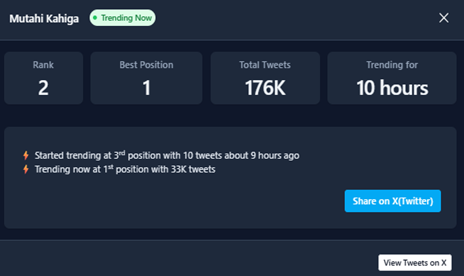
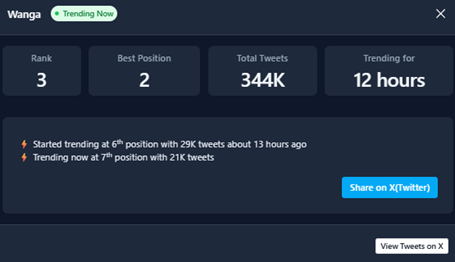
Facing mounting pressure, Kahiga apologised to the Odinga family, ODM, the Luo community, and Kenyans at large, claiming his words were misinterpreted and represented personal opinions rather than official positions. Despite his resignation as Council of Governors (CoG) vice chairperson, the CoG unanimously voted to remove him during an extraordinary meeting on October 22, while calls for his impeachment as governor continue to grow. Wiper leader Kalonzo Musyoka, representing the United Opposition, also issued a statement on his official X account on October 22 reinforcing this position, as the United Opposition through spokesperson Mukhisa Kituyi labeled Kahiga’s comments as hate speech. Online, the controversy dominated discourse as #MutahiKahiga trended from October 21–23, peaking at position one with 1.4 million tweets after trending for 20 hours, while Homa Bay Governor Gladys Wanga, who condemned Kahiga’s remarks as “reckless and shameful,” trended at position two with 344K tweets after 12 hours, following her own backlash for politicizing the mourning period.
Citizen TV Kenya amplified the story through a report titled “Kahiga celebrates Raila’s death: Nyeri Governor says Raila’s death saved Mt Kenya from ODM’s influence,” which garnered over 800K views and 45K reactions, while Facebook users popularized the hashtag #MutahiKahiga, accelerating the story’s reach and shaping online conversations around political accountability, regionalism, and respect in national mourning.https://x.com/Honcalebamisi/status/1981253316907573334

Impact on media
The controversy surrounding Governor Kahiga’s remarks intensified media focus on issues of societal values and ethics, and responsible leadership. News outlets and talk shows dedicated significant airtime and column space to dissecting the implications of his statement, reflecting how quickly political narratives can dominate the news cycle. The story also highlighted how regional and ethnic sentiments continue to shape editorial framing in Kenya’s media landscape.
Mashujaa Day Marked by Mourning and Memory
Mashujaa Day on October 21, 2025 was observed under a subdued national mood following the death of former Prime Minister Raila Odinga five days earlier. Despite the somber atmosphere, celebrations at Ithookwe Stadium in Kitui County proceeded as planned, honouring 184 heroes in categories such as culture, innovation, and conservation. The day’s theme was adjusted to incorporate tributes to Odinga, underscoring his lasting political and social legacy. Digital media coverage remained vibrant, with Standard Digital livestreaming the event and capturing its colour and cultural rhythm. KTN News amplified engagement through short video clips highlighting youth participation, drawing over one million followers, more than 5,000 views per clip, and significant interaction through shares and comments. On Facebook, #MashujaaDay2025 and #MashujaaDay trended widely as users celebrated national pride while paying tribute to Odinga’s memory.


Impact on media
Following Raila Odinga’s death, media outlets incorporated emotional and commemorative tones into their Mashujaa Day content. This demonstrated a growing trend of integrating human-interest angles and reflective narratives into political and national coverage, signaling a shift from purely ceremonial reporting to more sentiment-focused storytelling that resonates with audiences online.
Judiciary halts contested cybercrimes law
The High Court suspended key provisions of the Computer Misuse and Cybercrimes (Amendment) Act, 2024, Sections 27(1)(b), 27(1)(c), and 27(2), pending a full hearing on November 5, 2025. The petition, filed by politician Reuben Kigame and the Kenya Human Rights Commission, argues that the amendments infringe on freedom of expression and privacy rights. The Act, signed by President William Ruto on October 15, seeks to curb online crimes such as child exploitation and cyberbullying but has faced backlash for its ambiguous language that critics say could facilitate state surveillance. The court’s intervention highlights growing tensions between digital security regulation and constitutional freedoms.
Impact on media
The suspension reassured journalists and digital content creators concerned about criminal liability for online expression. It momentarily eased fears that the vague provisions could be used to suppress critical reporting or investigative content shared on digital platforms.
Always pads scare sparks online uutrage
Viral TikTok and X videos by Kenyan women sparked public concern after showing what appeared to be mold and dark spots inside sealed Always sanitary pads. However, analysis reveals that the spots are caused by light being blocked by the superabsorbent polymer (SAP) gel, a water-absorbing material, rather than mold. Cutting open the pads exposes clear gel beads, confirming the claim. The renewed scrutiny follows advocate Joseph Mwai’s 2024 lawsuit against Procter & Gamble, accusing the company of distributing substandard products in African markets. The case, now deferred to 2025, has intensified discussions on product safety, consumer protection, and menstrual health standards. Despite mounting online outrage, the Kenya Bureau of Standards has yet to issue a statement. Meanwhile, users are increasingly promoting locally made organic sanitary alternatives, linking the debate to broader issues of period poverty, which affects an estimated 40 per cent of Kenyan women.
https://x.com/HustleBitch_/status/1980675881778421797
Impact on media The incident underscored how social media influencers and ordinary users now shape public discourse, with platforms like TikTok and X driving national attention faster than mainstream outlets. This trend has forced media houses to follow and fact-check viral claims in real time, demonstrating how digital platforms increasingly set the agenda in Kenya’s consumer and health reporting.